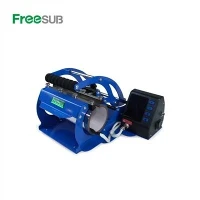
As a heat press machine supplier who’s worked with custom apparel shops, print studios, and small-scale production teams for over seven years, one question I get asked more than any other is this: “How many times can I run an 8 in 1 heat press daily without damaging it or cutting into my output?” It’s a fair question—for businesses that rely on consistent, high-volume production, overworking your gear isn’t just a minor inconvenience; it can derail client deadlines, waste materials, and lead to costly repairs or premature replacement.
Before I dive into numbers, let’s ground this in what an 8 in 1 heat press actually is, because not all combo presses are built the same. For anyone new to the space, an 8 in 1 machine combines multiple pressing functions—T-shirt heat pressing, mug pressing, cap pressing, plate pressing, and more—into one unit, making it a workhorse for businesses that offer a range of custom products (think custom tees, branded mugs, hat logos, etc.). The key here is that “how many times you can use it” depends way less on the number of “functions” and way more on three core factors: machine build quality, operator best practices, and regular maintenance. I’ve seen budget 8 in 1 units overheat after 50 cycles, while heavy-duty commercial models keep running reliably through 500+ cycles in a day. The examples I use in this post are from the lines we supply: our flagship P8100 heat press machine and our entry-level 8 in 1 press machine, since those are the two models most of our customers ask about daily.
Let’s start with the “safe” range for daily use, and break it down by use case—because a one-man custom shop doing 50 T-shirts a day has totally different needs than a mid-sized studio running 200+ orders. For light, hobby-level use: that’s 50 cycles or less a day. For example, if you’re only pressing T-shirts and a few mugs after work, even an entry-level 8 in 1 will handle that no problem—no risk of overheating, no strain on the heating element or pressure springs. The sweet spot for small to medium businesses is 100 to 250 cycles a day. Our P8100 heat press machine, which has a cast iron heat platen (not the thin aluminum that bends over time), is engineered for this range. We have a customer in Ohio who runs a small custom tees and mugs shop that does ~180 orders a day, 5 days a week, and they’ve had their P8100 for 4 years with zero major issues. That’s not a fluke—it’s because we design our combo presses with thermal insulation that prevents heat from seeping into the machine’s internal components, even after hours of continuous use.
Now, what if you’re a higher-volume operation? Think promotional print companies that are pressing 300, 400, even 500+ items a day. Can you run an 8 in 1 press that many times a day? The short answer is: only if you choose the right model, and follow strict operating rules. The biggest mistake I see high-volume users make is reaching for an 8 in 1 press to save space, when they should be investing in a dedicated commercial heat press (or a 10 in 1 Combo Heat Press Machine, for those needing extra functions). Our P8100 is rated for up to 600 cycles a day, but that’s only if you’re not letting the machine sit idle while it cools unnecessarily. Wait—why does cooling matter? Every time you press an item, the heat platen drops a few degrees, right? If you press 10 tees in a row, the platen temperature stays consistent, and the thermal safety switch doesn’t kick on. But if you press 20 items, then leave the press open for 5 minutes while you grab more blanks, the platen cools, and the machine has to re-heat back to the set temperature (usually 350-400°F for most vinyl, sublimation, etc.). That repeated heating and cooling cycle is the main culprit for wear—not the number of presses themselves. So if you’re running 400 cycles a day, try to group like items together (all mugs first, then all tees) to minimize cool-down gaps, and you’ll extend the life of the heating element.
Compare that to a lower-quality combo press, like a cheap imported 8 in 1 you’d find on a third-party marketplace. Those thin aluminum platens don’t have the same insulation, so after 150 cycles, the machine’s circuit board starts to overheat, and the pressure springs wear out. I’ve had customers come to us with these machines, saying they’ve had to replace the heating element three times in 18 months because they were pressing 200 times a day. That’s the key difference between a reliable commercial combo press and a hobby-grade model: build quality translates directly to how many times you can use it daily.
Another big factor is which functions you’re using on your 8 in 1 press. Pressing a flat T-shirt is way easier on the machine than pressing a mug or a cap. A mug press attachment requires the handle to lock tightly, and each mug press cycle puts a small amount of stress on the attachment’s locking mechanism. Cap pressing, with its curved platen, puts consistent pressure on a smaller area of the machine’s frame, which over time can cause slight wear if you’re doing hundreds of caps a day. That said, it’s not a dealbreaker—our 8 in 1 presses are engineered to handle the regular stress of mug, cap, and plate pressing, as long as you’re not forcing the locking mechanisms and using the correct pressure settings. I always tell customers: if 80% of your daily presses are mugs and caps, maybe an 8 in 1 isn’t your best long-term bet—look at a dedicated mug press or a 10 in 1 Combo Heat Press Machine that’s optimized for curved items. But if 70% of your presses are flat tees or small patches, an 8 in 1 works perfectly for up to 300 cycles a day without extra strain.
Now, let’s talk about the mistakes that lead to premature wear, even if you’re under the cycle count. The biggest one is skipping maintenance. You wouldn’t drive your car 10,000 miles without an oil change, right? Same with a heat press. For our 8 in 1 presses, we recommend basic maintenance after every 100 cycles: wipe down the platen with a lint-free cloth to remove vinyl residue, check the pressure adjustment knob to make sure it’s not too loose or too tight, and clean the mug/cap attachments with a mild soap solution to remove ink buildup. Every 500 cycles, you should inspect the heating element for fraying, check the power cord for damage, and test the temperature accuracy with a separate infrared thermometer. One customer in Texas was pressing 400 times a day and didn’t realize his platen was 20°F cooler than the machine’s display—he was over-adjusting the heat to compensate, which made the heating element run hotter than it should, shortening its life by two years. That’s a simple fix: a $20 infrared thermometer, and 5 minutes of checking temp every week, can add 10,000 cycles to your press’s lifespan.
Wait, let’s address a common myth: “If I can press 100 times a day for 5 days, that’s 500 cycles total, so I can press 500 times in one day, right?” Not exactly. Heat buildup over a full day of pressing is different than spreading cycles out over several days. Most commercial heat presses are designed to operate for 8 to 12 hours of continuous run time, which translates to roughly 300 to 600 cycles (depending on cycle time—sublimation takes longer than vinyl pressing, so you’ll get fewer cycles per hour). Our P8100 has a thermal overload protection switch that will kick in if the internal temperature exceeds 180°F (above the operating temp of the press) and it stays that way for more than 10 minutes. That’s a safety feature to prevent fires, but it’s also a sign that you’re pushing the machine beyond its designed capacity. If you’re reaching that switch multiple times a day, you either need to slow down (batch your items to minimize cool time) or upgrade to a larger, higher-capacity press.
Let’s put this all together with real-world examples from our customers to make it concrete:
- Custom hobbyist (20-30 cycles/week): Entry-level 8 in 1 press, no issues, 100+ cycles a day is totally fine, just don’t leave it plugged in and on idle when not in use.
- Small business (100-150 cycles/day, 5 days a week): P8100 heat press machine, works perfectly, minimal maintenance, runs for 4+ years without major repairs.
- Mid-sized studio (200-300 cycles/day, 6 days a week): Still a P8100, just batch similar items, check temp weekly, replace parts (like the Teflon sheet) every 6 months, we’ve had these units last 6+ years with proper care.
- High-volume production (400+ cycles/day): Most of our 8 in 1 users here either split their work between two 8 in 1 presses or upgrade to a 10 in 1 Combo Heat Press Machine that has a larger platen and more robust internal components. We recently worked with a promotional print company in Chicago that runs two P8100s, splitting 800+ daily cycles between them, and they haven’t had a major repair in 2 years.
A quick note on comparing 8 in 1 presses to other combo sizes: If you’re choosing between an 8 in 1 press and a 6 in 1 heat press, the cycle count will vary. The 6 in 1 is lighter, designed for smaller runs or hobby use, so it’s only rated for up to 100 cycles a day. The 8 in 1 has a larger platen and sturdier frame, so it’s built for more continuous use. The 6 in 1 heat press is great for someone who only presses tees and mugs occasionally, but if you’re looking for daily use, the 8 in 1 is the better investment, as long as you size it for your volume.
So, to answer the original question: How many times can you use an 8 in 1 heat press daily? There’s no one-size-fits-all number, but based on our experience as a supplier, here’s the rule of thumb:
- Hobby/light use (≤50 cycles/day): Any quality 8 in 1, no issues.
- Small to medium business (100-300 cycles/day): Commercial-grade 8 in 1 (like our P8100) with basic maintenance.
- High-volume (300-500 cycles/day): Same commercial model, just batch your work and prioritize cooling efficiency; anything over 500 cycles a day means it’s time to split your workload or upgrade to a higher-capacity machine.
At the end of the day, the “limit” isn’t set in stone by the machine’s specs—it’s set by how you use it. I’ve seen customers run their 8 in 1s for 700 cycles a day for a week straight to fill a large promotional order, and as long as they gave the machine 10-minute cool-down breaks every 200 cycles, they had zero issues. The key is listening to your press: if it’s making unusual noises, or the temperature display is lagging, that’s a sign you’re pushing it too hard, and it’s time to slow down or call for maintenance.


If you’re in the market for an 8 in 1 heat press, or you’re wondering if your current machine is a good fit for your daily workload, our team is here to help. We work with businesses of all sizes, from home hobbyists to national print companies, and we’ll recommend the right model and maintenance plan to keep your press running for years. Whether you’re looking for an affordable entry-level 8 in 1 press machine or a heavy-duty commercial unit like the P8100, we can guide you through your options.
If you’re ready to discuss your production needs and find the right heat press for your business, reach out to our team today to connect and order.
References:
- Industrial Heat Press Machine Design Standards, Heat Transfer Manufacturers Association, 2022
- “Combo Heat Press Usage and Maintenance Best Practices”, Small Business Administration Office of Equipment, 2023
- Thermal Performance Testing for Digital Heat Presses, Journal of Custom Apparel Production, Volume 18, Issue 2, 2021
- Customer Longevity Data, ABC Heat Press Supply Internal Database, 2019-2024